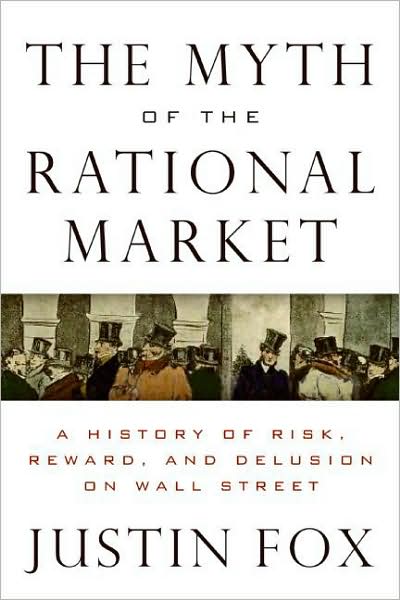
While the "The Myth of the Rational Market" is not directly related to the whole slew of the behavioral economics books (from Freakonomics to Predictably Irrational to Nudge), it forms a good complement to the current debate between Chicago school efficient market hypothesis and behavioral economics research.
The book, as Justin Fox himself notes at the beginning, is neither a polemic against everything related to efficient market research nor does it propose a solution for all that ail the current state of economics as an academic discipline. What it does is trace the evolution of economic thought, from classical economics to Keynesian economics to neoclassical economics to efficient market hypothesis to behavioral economics in the context of the current financial crisis.
As a history of academic thought, there is plenty of name-dropping: Einstein, von Neumann, Macauley, Samuelson, Walras, Keyenes, Irving Fisher etc. In the early days of academic economics, there was enough interaction between mathematicians and economists that the former made much contributions.
The main narrative was the rise (and fall) of the efficient market hypothesis. After WWII and the ascent of the Keynesian economics, the libertarian school of Hayak and Mises lay discredited. In this void came the Chicago school. While Milton Friedman was the most well-known personality of the Chicago school, he was far from being the only one: Lucas, Becker et al.
The efficient market hypothesis, which states that stock prices encapsulates all available information, has the implication that the market cannot be made better: not government intervention of any sort. This dovetailed with the ascent of Reagan and deregulation.
Of course we know what happened. The market is not as efficient as was thought. And the obvious question is why. This is where we are right now- and the current research agenda of behavioral economics.


No comments:
Post a Comment